


Four Different Schools of Course Design: Meet the Course Designers of the Perlage CAVALIADA Tour 2026/2027
Four cities, four courses and four different approaches to what makes a jumping track challenging, fair and exciting. During the 2026/2027 season, the most important jumping classes of the Perlage CAVALIADA Tour will be designed by Szymon Tarant, Bart Vonck, Andrea Colombo and Gérard Lachat. All four have extensive international experience, but each of them creates a different set of questions for horse-and-rider combinations.
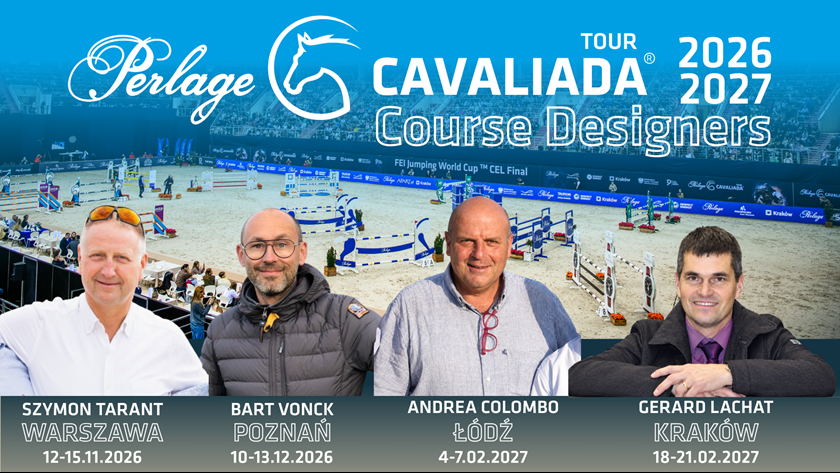
Szymon Tarant will design the courses in Warsaw, Belgian course designer Bart Vonck will take over in Poznań, Italian Andrea Colombo will be responsible for Łódź, while the final of the series in Kraków will be designed by Gérard Lachat. These are not simply four names on the list of officials. They represent four different approaches to course design — and therefore four different tests for the horse-and-rider combinations.
Warsaw: Szymon Tarant and the questions hidden in the rhythm
The 2026/2027 Perlage CAVALIADA Tour will open in Warsaw. From 12–15 November, riders will meet at Torwar, with the most important jumping classes also forming part of the Central European League World Cup competition.
The course designer will be Szymon Tarant, one of Poland’s best-known international course designers. He is listed by the FEI as a Level 3 Course Designer.
Tarant has extensive experience at top-level events in Poland, including the CSIO5* in Sopot, as well as World Cup competitions. Another important part of his career has been working as an assistant to internationally recognised course designers.
What can riders expect from his courses?
In Tarant’s courses, rhythm and time pressure can play an important role. A good example is his Nations Cup course in Sopot, where the FEI highlighted that, despite the course appearing relatively straightforward at first sight, several technical elements combined with the time allowed had a significant impact on the results. The water jump was also one of the elements requiring particular attention.
This reflects an approach in which the course does not necessarily have to make every single obstacle extremely difficult. Instead, the challenge can be distributed across the whole round: maintaining the right pace, planning the route correctly and keeping the rhythm at key moments.
In Warsaw, riders will therefore need to pay attention not only to the height of the fences, but also to:
- the time allowed,
- the length and flow of individual lines,
- places where a change of rhythm can lead to a mistake,
- technical combinations,
- obstacles requiring particular attention from the horse, including the water jump.
Tarant’s courses can therefore be seen as a test of control. The horse-and-rider combination needs to be fast enough, but at the same time cannot afford to lose rhythm or accuracy.
Poznań: Bart Vonck and the art of maintaining flow
In December, the series moves to Poznań. This is the largest venue of the Perlage CAVALIADA Tour, with two arenas and a Grand Prix counting towards the Central European League World Cup competition. The event will take place from 10–13 December 2026.
The CSI3*-W courses will be designed by Bart Vonck of Belgium. He is listed by the FEI as a Level 3 Course Designer.
Vonck is one of the designers whose international career has developed particularly quickly in recent years. He has designed World Cup courses in Jumping Mechelen and, since 2025, has been the course designer at CHIO Rotterdam, where his responsibilities include the Longines League of Nations and Grand Prix. He has also been part of course-design teams at the Olympic Games in Paris.
Interestingly, course design is not his only profession. Vonck works as an IT director at a school, while course design is his second professional career.
His trademark? Rhythm and forward flow
Vonck is particularly clear about his design philosophy. His approach is based on rhythm and forward flow. Rather than creating difficulty primarily through height or width, he focuses on technical finesse.
This means that in Poznań, a great deal may depend on what happens between the fences.
Riders will need to:
- maintain the correct rhythm,
- regulate the horse’s stride length appropriately,
- move smoothly from one line to the next,
- make decisions without excessive correction,
- maintain energy and concentration throughout the round.
Vonck has also explained that when designing Nations Cup courses, he starts by analysing the starting field. A team competition requires a different approach from an individual class, because the horses and riders will have to return to the arena for a second round.
His course therefore does not necessarily have to look spectacularly difficult. It may look smooth and elegant while demanding a very high level of control over the horse’s rhythm.
That is why, when watching a Vonck course, it is worth observing whether a combination can maintain its flow. If the rider constantly has to shorten, accelerate and readjust the canter, the course may already be asking one of its most important questions.
Łódź: Andrea Colombo and technical precision
In February 2027, the Perlage CAVALIADA Tour will visit Łódź for the second time. The event will take place at Atlas Arena from 4–7 February. Riders will also compete for FEI world ranking points.
The course designer will be Andrea Colombo, an Italian designer with FEI Level 4 status. His CV includes competitions at the highest international level, with one of the most important milestones being the 2023 FEI European Championships for Children, Juniors and Young Riders in Gorla Minore, where he was the main course designer.
Colombo also has experience in Poland. He previously designed courses at CAVALIADA Poznań, where Szymon Tarant worked as his assistant.
Not just height — technical skill above all
Colombo places particular emphasis on courses being fair, technical and appropriate for the level of the competitors. When preparing the European Championships, he analysed previous editions in order to assess the level of the riders and horses taking part.
This provides an important insight into his approach.
With Colombo, difficulty does not necessarily come from one spectacular obstacle. Instead, it can be distributed throughout the entire round:
- the quality of the approach,
- the correct length of stride,
- precise execution of combinations,
- control before the next fence,
- the ability to react correctly to a change of direction or fence type.
Colombo also has particular experience with water obstacles and the design of this type of element.
For that reason, Łódź could be a venue where a great deal depends on the ability of the horse-and-rider combination to solve technical problems together.
It will not be enough to have a horse that can jump high. The horse will need to be attentive and adjustable, while the rider will need to recognise and solve the next question before it arrives.
Kraków: Gérard Lachat and the final test of precision
The series will conclude in Kraków. The final of the Perlage CAVALIADA Tour 2026/2027 will take place at TAURON Arena from 18–21 February 2027.
The course designer will be Gérard Lachat of Switzerland, one of the most experienced designers in this group. He is a FEI Level 4 Course Designer, with an impressive CV that includes the World Cup Final in Basel, CHI Geneva and CSIO St. Gallen.
Lachat is also well known to the CAVALIADA audience. At the 2026 Kraków final, he designed the 1.55 m Grand Prix course. Of the 37 horses that started, five combinations ultimately qualified for the jump-off.
After that final, Szymon Tarant highlighted the concentration of difficult questions in the second half of the course, including a demanding triple combination, a difficult approach to another combination and a final line containing four jumps, including three oxers. The time allowed was also an important factor.
Technical difficulty rather than fighting the fences
Lachat’s philosophy is particularly distinctive.
The Swiss designer places strong emphasis on precision, rider decision-making and quality of canter, rather than creating difficulty by maximising the physical demands placed on the horse.
In his view, a good course should primarily produce small mistakes resulting from a lack of precision, rather than situations that lead to dangerous refusals or a loss of control.
This is particularly relevant in a final. At this stage of the season, riders cannot afford to rely on chance. The course needs to identify combinations that can maintain their quality of performance and concentration under the greatest pressure.
With Lachat, therefore, it is worth watching:
- the quality of the canter,
- the accuracy of the approach,
- distances within combinations,
- the way riders manage longer lines,
- the ability to maintain rhythm as pressure increases,
- time management.
His courses can look elegant while being exceptionally demanding.
Four course designers, four different questions
Although all four designers work at international level, their philosophies allow us to look at the different stages of the Perlage CAVALIADA Tour as four different tests.
Szymon Tarant will ask riders primarily for control of rhythm and effective management of the round. Time and several key elements may mean that an apparently flowing course quickly begins to cost faults.
Bart Vonck places particular emphasis on rhythm and forward flow. In Poznań, the ability to ride the entire course smoothly, without losing energy or constantly correcting the canter, will be crucial.
Andrea Colombo will bring a technically focused approach to Łódź. His experience at European Championships demonstrates the importance he places on matching the level of difficulty to the competitors. Here, the key will be the ability to solve a succession of technical questions presented by the course.
Gérard Lachat will close the series in Kraków. As a Level 4 designer and the man behind courses at the World Cup Final and CHI Geneva, he has extensive experience creating tracks where small details can decide the result. The final will therefore test not only the horse’s ability, but also the precision, experience and resilience of the entire combination.
From the first fence to the last
This is what makes the course designers one of the most interesting elements of the Perlage CAVALIADA Tour 2026/2027.
Riders in Warsaw, Poznań, Łódź and Kraków will not face four identical tests. Each designer has his own way of working with rhythm, distance, pace and technical difficulty.
For spectators, this means there is more to watch than four jumping competitions.
You can watch four different designers ask the same fundamental question: can the horse and rider work together to solve the problem placed in front of them?
And in February, in Kraków, the answer to that question will help determine the final outcome of the Perlage CAVALIADA Tour.